| I've recently been boning up on my html and css skills, so I thought I would post a project I worked on for practice: Zeppelin Albums: With Links! | ||
|---|---|---|
Thursday, March 21, 2013
Led Zeppelin

Wednesday, March 20, 2013
Murphy's Tattoos (part 2)
Unlike either the anchor or Antonio’s face, the tattooed figure “16” is a symbol that is presented but provided by the text with no naturalized signification or context to read it within (aside from its being inked on Murphy’s chest). The reader in this instance is forced to create signification of his or her own with little to no aid from Murphy (who dodges questions about what it means) or the chapter’s narrator (who just describes its presence on Murphy’s chest and provides no further commentary). A reader of the “16” is thus challenged to either create significance for this figure or to ignore it. One way a reader can create signification for the enigmatic “16” is to move outside of the text and attempt to find signification from some other source. One example of this strategy is provided by critic Don Gifford who, in his Ulysses Annotated, posits that, “in European slang and numerology the number sixteen meant homosexuality” (544). Once significance is attached to the “16,” this significance can shift the meaning of the other two tattoos on Murphy’s chest. For example, if one reads the “16” the way Don Gifford suggests, as associated with homosexuality, then the presence of the “16” inked near the profile of Antonio’s face could lead a reader to now associate Antonio and Murphy as lovers. Gifford may be correct in his attribution of the number “16” with homosexuality, but this tattoo appears in chapter sixteen of Ulysses. Even if an extra-textual meaning or signification is affixed to a symbol within the text, there is no guarantee that applying this meaning back to the text will elucidate anything. Any meaning a reader or critic may propose about the significance of “16” can be undercut by its appearance in the sixteenth chapter of Ulysses, as this would provide, perhaps, the simplest answer to the meaning of the number. Thus, the problem of assigning definitive signification to a signifier that is not clearly delimited by its text proves to be a precarious task.
 The problem of creating meaning is further complicated in chapter sixteen when the reader is forced to question the authenticity of Murphy as a seaman. On at least three separate occasions in the chapter, Murphy’s credibility as a narrator and mariner is called into question. These instances include: his claims to have seen Simon Dedalus in Stockholm shoot two eggs off of bottles over his shoulder [a highly improbable claim]; his confusion regarding the geography of Gibraltar when questioned about it by Bloom; and his presentation of a group of postcards as evidence of his travels, but are addressed to someone else [“Mr. Bloom, without evidencing surprise, unostentatiously turned over the card to peruse the partially obliterated address and postmark. It ran as follows Tarjeta Postal, Senor A Boudin, Galeria Becche, Santiago, Chile. There was no message evidently, as he took particular note.” (512)]. Based on this evidence, it could be concluded that Murphy had never traveled and that he did not receive his tattoos from Antonio in Odessa.
When the possibility of Murphy as a liar and unreliable narrator is considered, one could ultimately come to the conclusion that all meanings and context he provides regarding his tattoos are false and that the meaning one finds therein is compromised. If this is the case, then the reader of chapter sixteen of Ulysses finds him or herself in a position that forces him or her to treat all of the tattoos, and not just the figure “16,” as being without a clear textual context.
Some readers may find this playing with definitive meaning frustrating, or as an end game on Joyce’s part that avers that if meaning is undercut then a text becomes meaningless. Joyce challenges this possible view of meaninglessness, however, with Bloom’s reaction to his discovery of the “false” postcard address: “Though not an implicit believer in the lurid story narrated [by Murphy]...nevertheless it reminded him in a way of a longcherished plan he meant to one day realise some Wednesday or Saturday of traveling to London via long sea” (512). While Murphy’s narrative may be completely false, it does provide Bloom with an avenue to access and reflect on his own life and recall his dream to take a boat trip to London. Whether or not Bloom will ever take this trip to London is left to the reader to decide. Bloom is not concerned with creating signification out of Murphy’s story or tattoos, or very bothered by the fact that everything Murphy says and represents may be false, rather, Bloom uses Murphy to come to a personal understanding about his own life. This may be what Joyce desires of his readers: you may argue and search for meaning where there may or may not be any, but in the end, the meaning that matters is the meaning a signifier signifies to an individual reader and to his or her own “real” life.
Ulysses is a text that creates meaning and signification in a way similar to Murphy’s tattoos. With the tattoos, the reader is presented with threes different symbols (on one space, Murphy’s chest) that create meaning in three differing ways. Likewise, Ulysses is a novel, or singular space, that incorporates many different genres and styles of writing that create meaning in their own unique ways. From the discourse of the newspaper headlines in “Aeolus,” to the dramatic form of “Circe,” and the scientific Q&A of “Ithaca” (not to mention the tour de force of styles co-mingled the “Oxen of the Sun”), Joyce fills each chapter of his novel with a different form of signification ability. This does not mean that the text is meaningless, but that the possibility for meaning approaches limitlessness. By challenging the ability of a reader to arrive at a definitive meaning for his text, Joyce ends up subverting the naturalized meanings of words, symbols, and allusions and creates a text that a reader can interact with, in a different way, each time they approach it.
Next time...Led Zeppelin
Tuesday, March 19, 2013
Murphy's Tattoos (part 1)

James Joyce’s Ulysses is a text heavily invested in questioning language’s ability to create, subvert, and play with the nature of meaning. Therefore, what happens in Ulysses, from the perspective of plot, is often times less important than how something is spoken about in the text. In chapter sixteen of Ulysses, Joyce presents his reader with the long anticipated meeting of Leopold Bloom and Stephen Dedalus, which is arguably one of the most important plot points of the novel. While the awaited convergence of these father and son figures comes to fruition in this section, other characters populate the cab shelter the two find refuge in and at times seem to be of more import to the narration than Leopold and Stephen themselves. One of these periphery characters, who moves to the center of this chapter and seemingly subverts the “plot” of the text, is the yarn-spinning sailor D. B. Murphy. Murphy, in this chapter, for awhile usurps the position of Odysseus from Bloom and enacts the role of the long traveled mariner who has returned home and litters the chapter of Stephen and Leopold’s “reunion” with tales of his life at sea, his estrangement from his family, and his homecoming to Ireland.
Concomitant to Murphy’s story telling in this chapter is the presence of three tattoos he shows to his audience. “Seeing they were all looking at his chest [Murphy] accommodatingly dragged his shirt more open so that on top of the timehonoured symbol of the mariner’s hope and rest they had a full view of the figure 16 and a young man’s sideface looking frowningly rather” (516). I believe these tattoos can be read as an illustration of the process whereby multiple meanings are created as Joyce draws together accepted, manipulated, and enigmatic significations of symbols on the singular space of Murphy’s chest. This process can also be read as one of the ways Joyce creates and incorporates multiple meanings into Ulysses as a whole.
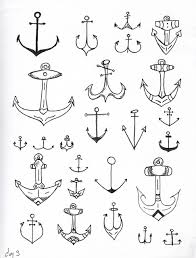
The first of Murphy’s tattoos to look at is the anchor. As noted in the above quotation, the anchor is presented as representative of a sailor’s hope and rest, a traditionally accepted and naturalized meaning of the anchor as a symbol. A real anchor fixes a ship in one place and allows the mariners on a ship a respite from travel on the sea. Anchoring a ship can provide temporary relief for sailors if it stops a ship’s movement in a port of call and it can also provide a form of permanent stoppage if it is used to moor a ship in a homeport. When anchored, the dangers of the sea are abated and a sailor is allowed to rest and reflect on his travels and take up land life once again. As such, the symbol of an anchor, as commonly accepted based on these maritime realities, is a mark that represents safety and hope of another day. The meaning of the anchor, in this context in chapter sixteen, is fixed by the narrator and is also fixed by a reader who accepts the naturalized meaning of this “timehonoured” symbol. The meaning of the anchor tattoo is thus presented, agreed upon, and slips out of discussion in the text.
Inked above Murphy’s anchor is another tattoo: the profile of a man’s frowning face. In this instance, the significance of this symbol is not as clear as that of the anchor, as its meaning is not explicitly delineated by the narrator of the chapter—a face could be representative of any number of meanings. While the face is not initially imbued with specific meaning, Murphy later reveals that the face tattooed on his chest is that of man named Antonio who, after inking the three tattoos on his chest, was eaten by a shark. The biographical information provided by Murphy begins to create significance for the tattooed face and provides a context for the reader of Ulysses to read the tattoo in to. Because the face is that of a frowning seaman, and specifically that of the creator of Murphy’s tattoos, a reader could associate the tattooed face with Murphy’s travels on the sea, his life aboard ship with his fellow mates, or as an example of tattoo portraiture work (among other possible associations). While the biographical information begins to give significance to Antonio’s face, the meaning a reader begins to assign to this tattoo is played with because Murphy, while speaking to his listeners about the face tattoo, “was busily engaged in collecting round the. Someway in his. Squeezing or. –See here, he said, showing Antonio. There he is cursing the mate. And there he is now, he added, the same fellow, pulling the skin with his fingers, some special knack evidently, and he laughing at a yarn” (516). Joyce shows Murphy here as possessing the ability to manipulate the tattoo of Antonio’s face and its emotional resonance: Antonio can be made happy and smiling, or angry and frowning by Murphy’s deft fingers. This is an interesting trick as tattoos are normally given the signification of being a permanent art. Once the ink of the tattoo artist has been placed under the skin, it is there to stay. By manipulating the tattoo, and coupling this manipulation with the back-story about it and its creator, Joyce provides his reader with two distinct ways to contextualize Antonio’s face. Between these two poles, of back-story and smiling/frowning faces, a reader is allowed to shift between different meanings in the fixed context Joyce provides. Murphy’s tattoo appears to be set in its meaning, but as Joyce shows, through Murphy’s playing with Antonio’s face, no meaning, however permanent it may appear, is immune from being manipulated. A modicum of fluidity is thus associated with Antonio’s face through its manipulation, but the multiple meanings that can be arrived at here are still somewhat controlled by the contextual auspices the reader has been provided by from Murphy, the narrator of chapter sixteen, and, ultimately, Joyce himself. Although the fluidity of meaning surrounding Antonio’s face is not absolute, its possibility differentiates it from the anchor tattoo, as discussed above, whose meaning is delineated for the reader without manipulation or play.
Next time...Murphy's Tattoos (part 2)
Monday, March 18, 2013
Finnegans Wake

The oaks of ald now they lie in peat yet elms leap where askes lay. Phall if you but will, rise you must: and none so soon either shall the pharce for the nunce come to a setdown secular phoenish.
Tuesday, December 11, 2012
Jessica Benjamin

I’ve recently been reconsidering Derrida’s influence on the theorists I’ve been reading over the last month or so (as can probably be gathered from the last few posts). Today I am interesting in continuing this thread and looking at Derrida’s fingerprint on Jessica Benjamin’s text The Bonds of Love. After this post, I promise to take a break from post-structuralist readings of feminist and post-colonial theoretical texts.
In The Bonds of Love, Jessica Benjamin seeks to explore the binary oppositions that she sees operating in contemporary society, especially those between male/female; subject/object; master/slave; dominated/dominator. In her text, Benjamin begins by looking at the harmful relationships of domination that people find themselves in. These relationships are characterized by a loss of subjectivity by one person in the relationship and the usurping of this subjectivity by the other member. Once subjectivity has been usurped, violence can take place between these two parties, where one acts violently upon the other. This violence need not be physical or outright abusive, rather, it can be manifest when one person exerts power over another. (Benjamin acknowledges that there are relationships of sadomasochism that seem to find pleasure in pain, but argues that these relationships many times do not embody a total lack of subjectivity). When it comes to the violence that happens between people, it is clear that Benjamin is using Derrida’s notion of the violence that happens within the framework of the binary opposition. One term of the binary is always given privilege over the other. Benjamin is concerned with relationships of domination and, after showing how these relationships fall into Derrida’s binary formulation, seeks to “play” with them and come up with a solution to the problem of domination.
Benjamin’s solution is to retain the tension between the two terms of the binary opposition, which is an idea that Freud and Hegel (as Benjamin points out) say is impossible. Freud would argue that the unresolved tension would cause neurosis and Hegel would argue, from the dialectical standpoint, that the tension cannot last and will eventually resolve itself in a linear and possibly violent fashion into a new, third term (or synthesis). While Freud and Hegel would say that Benjamin’s idea of binary tension cannot work, Derrida would say that it can. Although Benjamin does not use Derrida’s term “play” frequently in her text, the continued tension she describes is an illustration of this play, or if you will, of Derrida’s idea of “differance” (to differ and to defer so as to never arrive at a set meaning or dialectical synthesis). The interesting part of Benjamin’s formulation is that (along the lines of Cixous) she seeks to create relationships of subject and subject, where two individuals meet on similar terms and are thus able to relate and not commit violence against one another.
Monday, November 19, 2012
Albert Memmi

In this post I am interested in reading Albert Memmi’s The Colonizer and the Colonized as an example of a nascent post-structuralist text. While The Colonizer and the Colonized does not mention Derrida specifically (in fact, I believe it was penned before Of Grammatology), it none-the-less employs notions of the binary opposition, play, and differance.
The title and structure of Memmi’s text reinforce the notion of the binary opposition. The text is titled to show that opposition between these two terms/groups and the book itself is divided into two major sections, one of which deals with the colonizer and the other with the colonized. Memmi shows that the colonizer is in a privileged position in relationship to the colonized. Even colonizers who claim not to gain from the colonial system still receive benefits (i.e. you may be a poor white French man in Algeria during the occupation, but if you go to the colonial run post office, you will be able to move to the front of the line ahead of the colonized). The privileged position of the colonizer also entails a level of violence. The colonial “master” is able, and encouraged by the colonizer/colonized binary to commit acts of violence because he sees himself as being over the one he punishes.
Asides from the binary opposition and violence found between the colonizer and the colonized, Memmi argues that the colonizer will do everything in his power to repress the colonized and keep the binary opposition in place. For example, Memmi points out that in later colonialism, religion and the church were sought to be marginalized by colonial administrators because, as Memmi argues, if the colonized got religion and shared a similar religion with the colonizers, then it was harder for the colonizers to punish the colonized because they were now somewhat like each other. To use Derrida here: the colonizers feared that the binary colonizer/colonized would collapse because if part of them (their Christian religion) could be found in the lower half of the binary, then the binary and their privileged position would be deconstructed.
Memmi concludes his text by saying that the binary opposition of colonizer/colonized must be completely dismantled for colonialism to come to an end. Since the collapsing of the binary opposition would end colonialism and the perks the colonizers receive from the system, the colonizers strive to keep the binary in place while the colonized must seek to deconstruct it.
Next time...Jessica Benjamin
Wednesday, November 7, 2012
Helene Cixous

Cixous is interested in using deconstruction to explore the binary oppositions that exist between the terms male/female, self/other, and subject/object. In her text The Newly Born Woman (co-authored with Catherine Clement) Cixous argues against what she labels the “empire of the self-same.” The empire of the self-same is basically the mono-sexual descriptions of the world that have been passed down through history and have been recapitulated by patriarchal psychoanalysis. Cixous points out that women are not seen as women, per se, rather, they have (and are) viewed as little men with small deformed penises (clitoris). This idea is one that is shared and pointed out by many other feminist theorists (including Luce Irigaray), but a difference extant in Cixous’s work is that she also argues that the empire of the self-same is harmful to men as well as women. Cixous claims that men suffer to fit into the patriarchal roles that have been assigned to them as well.
Cixous believes that Freud and other psychoanalysts are too concerned with physical sex and wants to move the discussion to the idea that humans are bi-sexual. This is not bi-sexuality in terms of physical sexual preference for both male and female partners, rather, it is the notion that men and women both share elements of the opposite sex. Cixous believes that based on this idea, there should be a shift that takes place in the relationship between the self and other. She points out that in traditional patriarchal formulations of society, the other is seen as an enemy and thus something that needs to be murdered (violence is one of the hallmarks of the patriarchal world Cixous wants to challenge). Cixous believes that instead of seeing the other as a threat and killing it, there needs to be an acceptance of the other and a new love relationship needs to be formed that incorporates both sides of the subject/object binary opposition. One way this can be accomplished is through the development of a feminine ecriture, or a writing that seeks to disassociate itself from the power structures of patriarchal Western society. Cixous is careful to point out that feminine ecriture is not mere identification with a feminine point of view (for example, a patriarchal male could write a novel from a female point of view, but is will still encompass patriarchal violence [and many times men write women “better” than real women really are]). Cixous also avers that she cannot provide a concrete definition of what this writing looks like, though many argue that novels such as Carol Maso’s Ava and Kathy Acker’s Pussy, King of the Pirates could provide a picture of what this type of work is like.
Next time...Albert Memmi
Subscribe to:
Posts (Atom)